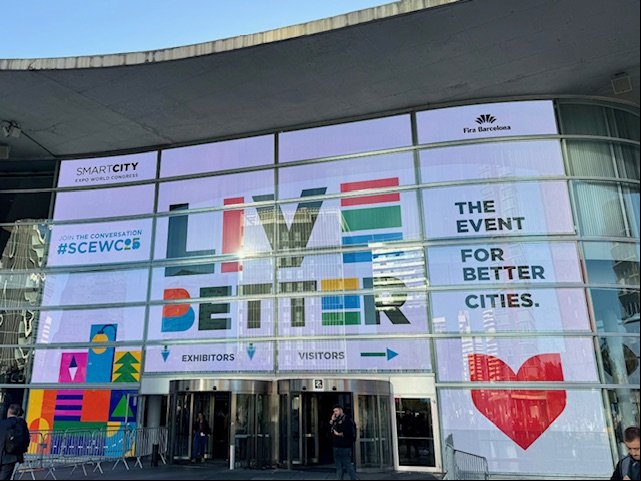
In November 2025 I finally made it to Barcelona for the Smart City Expo World Congress — an event that had been on my list for years. When I left the NSW Government at the end of last year, the timing worked out perfectly. I went independently, as part of the Australian and New Zealand delegation of 30-plus people organised by the Australian Smart Communities Association.
It was the event I had hoped for in many ways. The energy, the people, the sheer density of ideas in one place. 800 cities, 140 countries, thousands of conversations across three days. I came away energised — and deeply concerned about where Australia is heading.
What the expo actually is
It helps to understand that the Smart City Expo is really two events running simultaneously. The first is a trade show — vendors showcasing their latest products, from city management platforms that synthesise data from thousands of sensors, to transport technology, air quality monitoring, emergency response systems, and yes, battery-powered mobility soles you clip to your shoes. If you want to understand the landscape of available technology, it is genuinely unmatched.
The second event is an ideas exchange — cities and countries presenting themselves, showcasing what they are doing, inviting investment and collaboration. Countries sponsor their own booths. City managers take the stage. Governments signal what they believe technology's role should be in shaping the places their communities live in.
These two events coexist, and they don't always talk to each other as well as they should. But when they do connect — when a city on stage is demonstrably using a technology on the floor to solve a real community problem — the effect is compelling.
What the leading cities have in common
I went looking for the next-stage thinking — what are the world's leading cities doing that we aren't? What I found was less about technology and more about conditions. The cities doing this well — Rome, which won the Smart City of the Year award, Barcelona, Belfast, cities I spoke to from North Texas to Bavaria — shared roughly four things:
- Confirmed, consistent funding
- Coordination at the city level — someone with genuine responsibility
- Appropriate governance
- Executive and political support that was sustained, not episodic
None of that is about technology. It is about will and structure. The technology, as one conversation after another made clear, is not the constraint. Anything can be done. The question is whether there is the political appetite, the funding model, and the coordination mechanism to actually do it.
"The best cities aren't the ones with the most sensors. They're the ones seriously listening to their communities and committing to use technology as part of the answer."
It is also worth noting that Rome's win didn't come with much visible branding. No "smart city" signs. No labelling. The technology was simply embedded in how the city operated. The most successful cities are moving beyond the terminology altogether — they are just getting on with it.
Where Australia wasn't
Of the 800 cities represented at the expo, none were Australian. To put that in perspective: Sydney, Melbourne and Brisbane would rank somewhere between 50th and 80th globally by population. We were not on stage. We did not have stands. We were not, in any meaningful sense, present on the global stage of the sector we have been investing in for years.
That absence is not just symbolic. It reflects something deeper about where Australian policy appetite currently sits. Federal government funding for this agenda effectively stopped around 2018. In New South Wales, where I spent six years building what I believe was genuinely world-class work — establishing NSW as Australia's centre of excellence in smart and connected technology, $100 million in new investment, globally recognised programs — that agenda is now being wound back. Resources, guides, standards, public artifacts that took years to develop are being removed.
A striking indicator: the 2018 Sydney Region Plan included the word "smart" 19 times, with digital, technology and data woven throughout. The new Sydney Plan, currently on exhibition, mentions "smart" zero times.
I am not suggesting state government has stopped using technology. It has. But it is doing so in verticals — in siloes. And one of the things that global experience consistently tells us is that the value of this agenda comes from coordination, from freeing up data to flow across boundaries, from treating digital infrastructure as infrastructure. We appear to be going in the opposite direction.
The risk now falls to local government
As federal and state appetite recedes, the weight falls on local government. And whenever I talk to anyone in local government, the picture is the same: more is being asked of them, and less funding is coming from above. They are being asked to carry this forward at exactly the moment when the challenges — housing, climate resilience, digital inclusion, transport — are becoming more acute, and the technology needed to address them is more available than it has ever been.
Local government capability is real. I believe it is there. But the structural conditions — the funding certainty, the coordination mechanisms, the political cover — are not.
What I brought home
My headline from Barcelona is this: we should stop talking about smart cities and start talking about great cities. Great places. Technology has an essential, integrated role to play in achieving them — in managing our cities more efficiently, in making better planning decisions, in ensuring that the communities being built today have the digital infrastructure they will need. We know how to do this. The template exists.
What we are missing in Australia, right now, is the political appetite to apply it. That is not a technology problem. It is a leadership problem — and it is one that the sector, industry associations, local government, and advocates need to name clearly and push back on.
Barcelona reminded me why this work matters. Coming home reminded me how much work there is still to do.
This article is adapted from Rory Brown's contribution to the Australian Smart Communities Association webinar, International Trends and Insights from the Smart City Expo World Congress 2025, presented in February 2026. To watch this webinar, join ASCA at australiansmartcommunities.org.au →